

THE SETTLEMENT DOCUMENTS
Provided By:

Clear Evidence
– JOSH KOSKOFF
LIFTING THE VEIL OF CORPORATE SECRECY
Over the life of the case, the Sandy Hook families have obtained thousands of pages of internal documents and conducted multiple depositions of Remington’s leadership and marketing teams. The documents prove Remington’s wrongdoing and carry important lessons for helping to prevent future mass shootings. This website provides public access to documents and findings. We are starting with some key documents and will continue to add to this site over the next several months, so be sure to check back regularly. If you would like to be notified when new documents are added, click here.
Note: All the documents made available for download are unaltered and have not been edited in any way.
TRENDING DOCUMENTS

SALES CHART
An internal sales chart from the Freedom Group vividly illustrates the remarkable growth in sales of AR-15-style rifles, from 73,619 to 2,116,080 over the span of just 14 years from 1998 to 2014. A period that coincides with the Freedom Group’s increased marketing efforts to reach younger end users. The data underscores the significant evolution and heightened demand for AR-15-style rifles within the firearms market during this period.
FREEDOM GROUP 2010 MARKETING PLAN
The Freedom Group strategically embraced cutting-edge marketing methods, particularly those harnessing the potential of social media and mobile platforms, with a primary focus on a younger, predominantly male consumer base.

FREEDOM GROUP GAMING STRATEGY
In the highly competitive firearms industry, licensing and trademark protection are rigorously upheld. In this case, an agreement between The Freedom Group (then also known as the Remington Arms Company) and Activision, the maker of the widely popular Call of Duty video game franchise, revealed a mutually beneficial arrangement.
The Freedom Group granted Activision access to its weapon simulations for use in Call of Duty…
MARKETING THE AR-15
THE FREEDOM GROUP 2010 MARKETING PLAN
The Freedom Group strategically embraced cutting-edge marketing methods, particularly those harnessing the potential of social media and In 2010, the Freedom Group used sophisticated marketing strategies to reshape the American gun industry. They aimed to safeguard their core products mobile platforms, with a primary focus on a younger, predominantly male consumer base. Their presentation, “The Freedom Group Marketing Plan,” delivered in February 2010, openly acknowledged the concerning rise of mass shootings, the profound societal consequences, and the potential threats these posed to the AR-15 market.
Beyond demographic considerations, this presentation conducted an in-depth exploration of the psychographic dimensions of their “end-users,” probing into elements such as youthfulness and disaffection. This inquiry encompassed an examination of their recreational preferences and the myriad challenges they confronted. Significantly, The Freedom Group sought to position the AR-15 as a remedy for the issues plaguing their youthful target audience, even in the face of the escalating menace of mass shootings —a stance prioritizing financial gains over safety.

THE FREEDOM GROUP 2010 MARKETING PLAN / PAGE 4
After acquiring Bushmaster and other firearm manufacturers, the Freedom Group introduced sophisticated (AR-15 style rifles) while upgrading marketing messaging, web sites and shifting marketing initiatives towards the internet. This transition allowed direct access to end users, including youth. Notably, they planned to target female and youth markets, demonstrating their commitment to expanding the AR-15 and firearm market to younger demographics.

THE FREEDOM GROUP 2010 MARKETING PLAN / PAGE 21
After acquiring Bushmaster and other firearm manufacturers, the Freedom Group introduced sophisticated marketing strategies to expand firearm sales, with a focus on the “end user,” not just the purchaser. Why? Because they planned to reach a younger demographic—building consumer profiles to understand the audience’s motivations and the “problems” they faced. Disturbingly, they looked to position their product as a solution to the “end user’s” problems.
GAMING
FREEDOM GROUP GAMING STRATEGY
In the highly competitive firearms industry, licensing and trademark protection are rigorously upheld. In this case, an agreement between The Freedom Group (then also known as the Remington Arms Company) and Activision, the maker of the widely popular Call of Duty video game franchise, revealed a mutually beneficial arrangement.
The Freedom Group granted Activision access to its weapon simulations for use in Call of Duty, while Activision gained the advantage of featuring realworld firearms. This relationship would help increase demand for both the game as well as the weapons featured in Call of Duty. This partnership exemplified the Freedom Group’s product placement strategy to build brand awareness and favorability among progressively younger, predominantly male audiences.
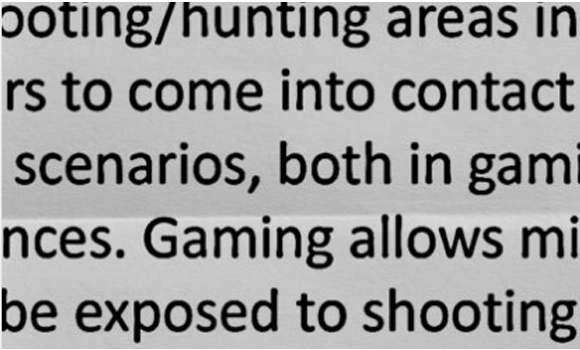
FREEDOM GROUP GAMING STRATEGY / PAGE 2
In response to declining access to traditional shooting and hunting areas, The Freedom Group aimed to connect with younger potential end users through virtual gaming. By strategically placing AR-15’s in gaming scenarios, the company sought to cultivate brand preference among with the “next generation.” This approach capitalizes on gaming platforms as a means to introduce their firearms to win their “fair share” of younger consumers.
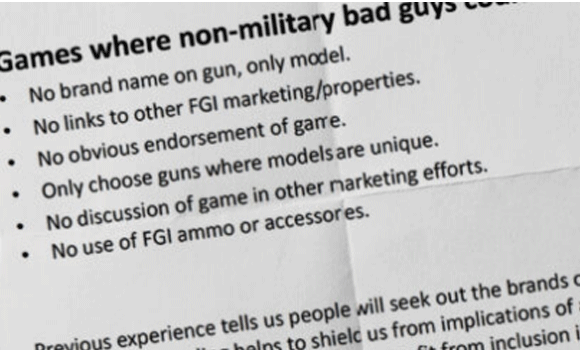
FREEDOM GROUP GAMING STRATEGY / PAGE 6
In an internal presentation, the Freedom Group outlined some of the ground rules whereby they would position their weapons in the context of video games. One slide within the presentation reveals a clear understanding on the part of the Freedom Group executives of the strong connection between the benefits of product placement and the inherent risk posed to the brand if they are perceived to explicitly endorse the way their weapons are portrayed.
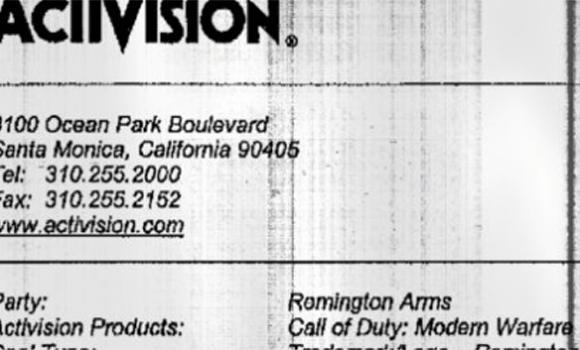
ACTIVISION CONTRACT
Among the key documents unearthed in this case was a contract that unveiled the intricate ties between Freedom Group (then also known as the Remington Arms Company) and Activision, the creators of the immensely popular Call of Duty video game franchise. This contract establishes a concerted effort by Remington and Activision to reach minors and younger gamers—placing a virtual assault rifle into the hands of impressionable children.

CALL OF DUTY EMAILS
Email exchanges among some of Remington’s executives demonstrate how company leadership recognized the powerful connection between the inclusion of their products in video games and brand recognition. A single short message in one of the email exchanges cites the irony of how video games, just a decade earlier, were viewed as a threat to gaining “new shooters” for Remington; however, now were “their number one draw.”
THE BUSINESS OF AR-15s
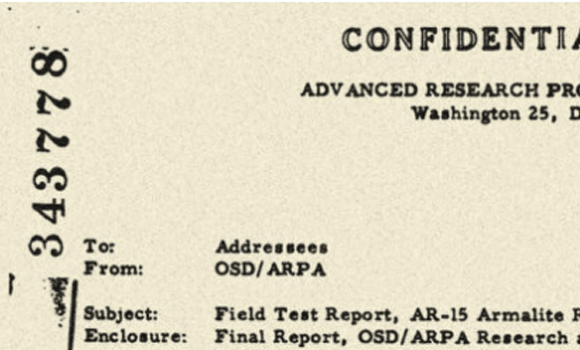
FIELD TEST REPORT, AR-15 ARMALITE RIFLE
In 1962, the Department of Defense conducted field studies in Vietnam to assess the AR-15 against other combat rifles. The report deemed the AR-15 to be one of the most lethal weapons ever introduced to the field. Designed to provide soldiers with a lightweight, lethal firearm—its instant and deadly impact was well documented. The U.S. military’s adoption of the AR-15 as the M-16 solidified its role in foreign conflicts, remaining a standard-issue rifle to this day.
Note: this document is publicly available
SALES CHART
An internal sales chart from the Freedom Group vividly illustrates the remarkable growth in sales of AR-15-style rifles, from 73,619 to 2,116,080 over the span of just 14 years from 1998 to 2014. A period that coincides with the Freedom Group’s increased marketing efforts to reach younger end users. The data underscores the significant volution and heightened demand for AR-15-style rifles within the firearms market during this period.
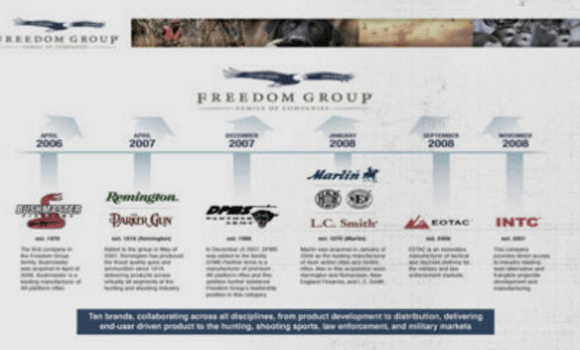
FREEDOM GROUP FAMILY OF COMPANIES
The private equity firm Cerberus Capital collected gun manufacturers and created an umbrella consortium called the Freedom Group. The Freedom Group touts its dominance in the AR market, citing acquisitions of smaller companies such as Remington, Bushmaster, and DPMS Panther as evidence of their market expansion and growth potential.
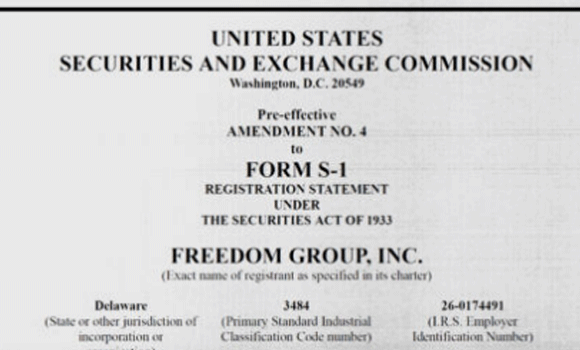
FREEDOM GROUP SEC FILLING
The Freedom Group’s SEC filing from May 2010, shows how investment interests in weapons manufacturers were garnering attention by private equity firms who saw financial opportunity in a growth market. In the filing, the Freedom Group makes their plans for future growth clear, emphasizing the market opportunity, particularly among a “younger demographic of users.”
The SEC filing, submitted more than 2 ½ years prior to the Sandy Hook shootings, outlines the Freedom Group’s ambitions to become a billion-dollar company by, in large part, increasing sales of AR-15-style rifles such as the ones produced by Remington Firearms. Note: this document is publicly available
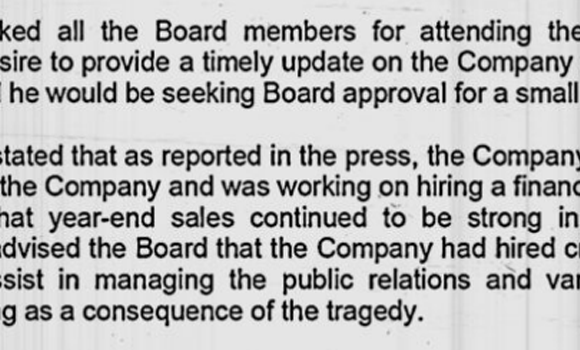
POST-SHOOTING BOARD MEETING
Dated December 20, 2012, just six days after the Sandy Hook shootings, the minutes from an emergency board of director’s meeting at Remington Outdoor Company noted, among other items, that year-end sales continued to be “strong” in the wake of the tragedy. Further, the minutes indicate the board’s unanimous approval to acquire another gun manufacturer for a purchase price of $6M — $7M.